International

The origin of the women’s movement goes back to the thinking inspired by the 18th-century Enlightenment. In 1791, the French author and revolutionary feminist Olympe de Gouges wrote a declaration of rights that was exclusive to women, “Déclaration des droits de la femme et de la citoyenne” – in English, The Rights of Women. Olympe de Gouges, whose proper name was Marie Gouze, was executed in 1793 for the crime of having criticized Robespierre. French women did not get suffrage until 1944.

Great Britain

“Déclaration des droits…” was a source of inspiration to Mary Wollstonecraft in her writing of A Vindication for the Rights of Women, in 1792. Though the start was quiet, the British suffragettes are noted for their startling methods. The meeting held in 1869 was the first known occasion of the suffragettes’ agitation for women’s franchise. Two years later, in 1871, The National Society for Women’s Suffrage was founded.

Emily Wilding Davison (Daily Herald, 1914)

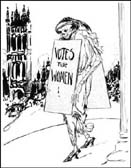
There were certain achievements, such as the female franchise obtained at the colonies New Zeeland (1893) and Australia (1902), but in Great Britain these were long in coming. Emmeline Pankhurst and her daughters Christabel and Sylvia grew tired of waiting and in 1903 they created Women's Social and Political Union, WSPU. They used more militant methods like stone-throwing and window-shattering. In prison, they went on hunger strike. In 1913, Emily Wilding Davison threw herself before the King’s horse at a horse race. She was wounded so severely that she later died from her injuries. The funeral turned into a great manifestation of the struggle for women’s suffrage. The struggle was interrupted when the First World War broke out. Women in Great Britain obtained franchise as late as 1928.

The United States of America

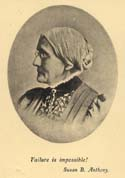
Susan B. Anthony:"Failure is impossible!"

In the United States, a women’s meeting was held at Seneca Falls in 1848. The women present at this meeting made a declaration, the Declaration of Sentiments. This was based on the American Declaration of Independence, with the addition of the word “women”, as in the following statement: “We hold these truths to be self-evident: that all men and women are created equal”. Slightly more than twenty years later, in 1869, American women established the first association for women’s rights, National Woman Suffrage Association, NWSA. Among the promoters were Susan B. Anthony and Elizabeth Cady Stanton. Further reading: National American Woman Suffrage Association Collection 1848-1921.


Denmark

In Denmark, women began their struggle for suffrage in the 1880s, and in 1889 the first “kvindevalgretsforening” (‘women’s association for franchise’) was founded. Line Luplau, who was married to a priest, was one of the promoters. The agitation was pursued through meetings and articles that contributed to the debate. Several organisations for suffrage were established, of which Danske Kvinders Valgretsforbund (‘Danish Women’s Association for Franchise’) and Landsforbundet for Kvinders Valgret (‘The National Association for Women’s Franchise’) were the biggest. These were not willing to cooperate and when International Woman Suffrage Alliance decided that each country could be represented by only one organisation, Denmark had to apply for exemption. The application was granted and Denmark was represented by both organisations. To begin with, the Social Democratics and Venstre (‘The Left Party’) supported the women’s claim for suffrage, together with many individual male sympathizers. One of these was Fredrik Bajer, who, together with his wife, founded Dansk Kvindesamfund (Women’s Association in Denmark’) as early as 1871.

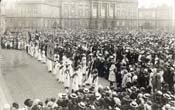
“Procession of thanks”, Copenhagen, 1915.]

In 1915, Folketinget (the Danish parliament) adopted a new constitution, which secured franchise for women. The women celebrated this achievement by organising a “procession of thanks”. The procession ended up at Amalineborg, where a letter of thanks was handed over to King Christian XII. 12-15,000 people participated in the procession.
Further readings: Danske kvinders kamp for stemmeret.
Den danske kvindevalgretskamp.


Norway

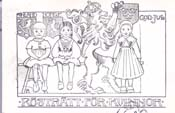
Suffrage for Women
Sitting: Finland, Norway
Suffrage for Women
Sitting: Finland, Norway

Norwegian women obtained political franchise two years earlier than the Danish women, in 1913, after a struggle which lasted comparatively as long as Denmark’s. Norsk Kvindesagsforening was founded in 1884 but was later split up because of the suffrage question. Gina Krog, who was considered to be much too radical, established then Kvindestemmerettsforeningen (‘The Association for Women’s Franchise’) together with some other women. This was split up in its own turn when Landskvindestemmerettsforeningen ( The National Association for Women’s Franchise’) was established. The reason for this divide was differing opinions about tactics, for instance the question whether an acceptance of municipal franchise might be sufficient to start with, or if an “all-at-once” claim should be made.

In 1901 women got municipal franchise, with eligibility to local communities. The Norwegian women’s and franchise movement was strongly engaged in the task of having the union with Sweden dissolved, e.g. by collecting names. Their action was then used as an argument for franchise, since it had proved that women were just as patriotic and good citizens as men. Read more about Stemmeret (Franchise) in Norway.

Finland

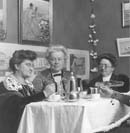
Women's Political Club, Helsinki 1913

Finland was the first Nordic country to introduce franchise for women, in 1906. Similar to the political context in Norway, the struggle for civic rights was linked to a national issue – the struggle for liberation from Russia. A central committee was appointed in 1905 for the purpose of uniting the two movements. The new constitution, adopted in 1906, stated that the Parliament should be founded on universal suffrage and equal eligibility for men and women. This means that in 2006, hundred years have passed since the first Nordic women obtained franchise – a historical fact that will be celebrated in many ways. Read more about Finska kvinnors politiska rättigheter, (‘The Political Rights of Finnish Women’).


Further links:

The Danish Tidsskrifter 1885-1920. Scanned women’s journals, e.g. Kindestemmerets-bladet (1907-1913).The search engine enables concurrent searches of all journals. The struggle in Sweden can be studied from a Danish perspective and there are also articles written by Swedish franchise women.
Women's Suffrage : a World Chronology of the Recognition of Women's Right to Vote and to Stand for Election
Votes for Women's Suffrage Pictures, 1850-1920.

Page Manager: Webmaster
Last update 2010-11-17 10:49

Printer version

© University of Gothenburg, Sweden 2009, Box 100, S-405 30 Gothenburg
Phone +46 31-786 0000, Contact

About the website | Map